

Threading
Soft Learning for Radical Electronic Practices

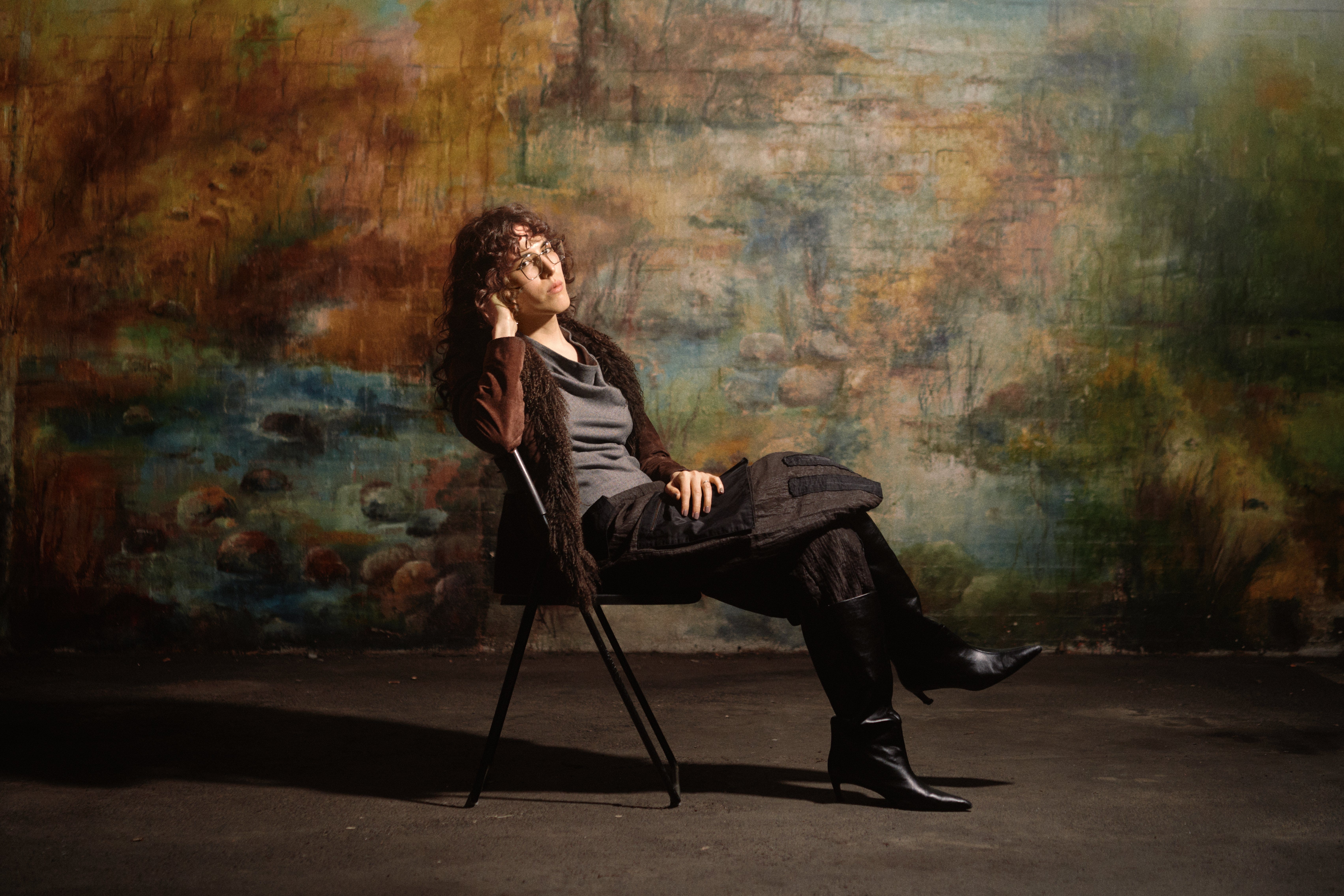
As a composer, digital artist, and curator, Asta Norborg has spent years exploring electronic music as something far beyond the club or concert format. Through projects like Kallelse at Inkonst and Rendered Voice at Museum of Sketches, as well as her own work under the name FASCIA, Norborg has consistently moved through the intersections of sound, performance, technology, and the body. Alongside this, Norborg has been active across a range of artistic contexts, including as curator for the queer literature organisation PAGE 28 and as one of the producers behind the drag show Club Mermaid.
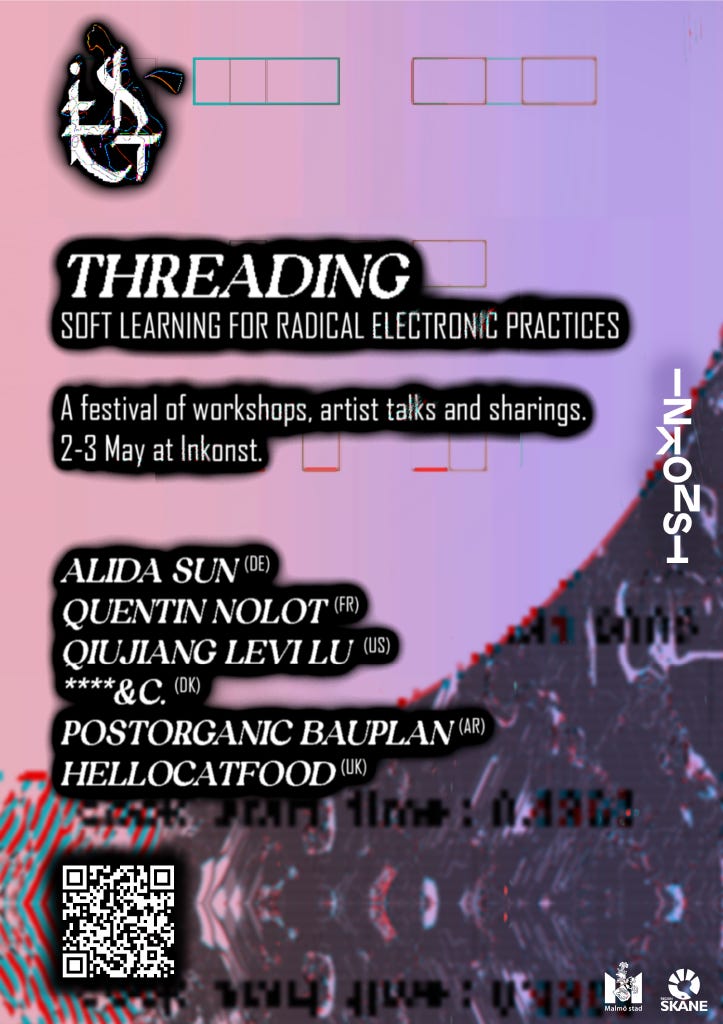
Last week she brought those threads together in THREADING, a new two-day festival in Malmö where workshops, artist talks, and performances explored what happens when biology becomes data, movement shapes sound, and the body itself becomes part of the instrument.
Before the festival I spoke to Asta Norborg about creating new formats for artistic learning, the evolving relationship between body and technology, and why the most radical ideas often begin from the hyperspecific.
Photos by Jeff Lennings
What gap did you see in the cultural landscape that made THREADING necessary and possible?
Asta: The subtitle of the festival is “Soft Learning for Radical Electronic Practices”. In practice, it’s a festival that aims to provide the audience with experiences, ideas, practices, and reflections in and around electronic music and new media art that are hopefully genuinely expansive for them. I saw a gap, or rather a possibility, in the practice of hosting workshops and sharings that don’t try to teach a general skill, but rather aim to deeply convey an artist’s specificity. In a way, starting from a hyperspecific point of view rather than a general one actually allows for a more accessible short-form educational program. I think a lot of people participating will experience things they genuinely hadn’t considered, and that alone makes a big difference.
There can be a certain conflict when evaluating art between seeing practice only as a means to an end, or only valuing technical proficiency, and neither of these fit my perspective. I think that advanced or innovative practice has the possibility of expanding our perception, of genuinely engaging with the world in new ways. That’s a gap I’m trying to fill, for sure. If the medium is the message, then I think it’s worth exploring the possibilities of shifting the medium.
The festival weaves together body, biology, and technology — what connects those threads for you?
Asta: I view the body primarily as a site of possibility, and to me that inherently comes with both a fascination and a lack of fear or disgust towards biology and technology intermingling. I have very little feeling of needing the body to be protected, or needing it to remain “natural”. The work of Post-Organic Bauplan, who are holding a performance and a workshop at the festival, engages very directly with this. What is most visually striking about their work is, of course, the prosthetic robotics they create and wear in their performance. But the deeper, more interesting layer, which will be explored in the workshop, is their use of biological sensors which generate the behaviour of the robotics. Their goal, as I interpret it, is similar to an artistic pursuit I’ve had myself: creating states where the relation to technology is non-hierarchical, and the resulting performance is co-created with the desires of the machine.
Qiujiang Levi Lu, however, is perhaps the only act in the festival whose practice manages to elicit a certain emotional provocation in me, a small feeling of lines being crossed that I needed to interrogate in myself. A through-line in their work has been to completely subsume the human body to the work itself, in a way that I interpret as a sort of temporary self-obliteration in pursuit of radical transformation. The piece they will be both performing and presenting involves the insertion of a custom speaker in their vocal chamber, projecting out into tubes connected to five trumpets through their mouth, both nostrils, and ears, all miked up and sending feedback to the inter-oral speaker. This causes the work to happen through them, and their one method of controlling the sound is the shape of the cavities of their head and throat. It’s a provocative and incredibly fascinating work that I feel a great deal of anticipation towards experiencing in person.
How do you view the relationship between the body and technology in today’s art landscape?
Asta: If we’re restricting the discussion to digital technology, my sense is that there’s an intensely growing fascination with exploring this connection.
There’s a growing desperation to find anything to latch onto for optimism towards technological progress, and embodiment remains one of the few sites for that optimism. Screen- and speaker-based media can increasingly be endlessly generated, and there’s a fundamental crisis of meaning inherent in that. I think people are dealing with loss in that sense, but there are exciting things happening in the attempts to fill that void. Just looking at online trends, there’s the cyberdeck movement, people creating computer wearables, and the trend of exploring webcam hand tracking (at least this is what’s in my feeds lol). I have ambivalent feelings towards some of these, but what connects them, I think, is a search for connecting technology back to both something material and something more democratic.
These questions certainly lie at the heart of the practices of several artists participating in THREADING. Alida Sun will be hosting an artist talk on the subject of embodiment + environment, ritual, and resistance in digital art practices, and her hand-coded practice deeply explores and engages directly with this. Quentin NOLOT’s practice also moves in these territories, with re-purposed Nintendo Wii controllers allowing for embodying their audiovisual practice. In that territory there’s finally also ****&c. (beep etc.), who will be performing and hosting a workshop, whose practice is largely a continuous repurposing of old technology through creative programming and circuit bending. For this festival, she’s presenting her microtonal practice using the GameBoy.
How do you curate work that is conceptually complex but still sensorially engaging?
Asta: I think exactly what you’re describing here is a through-line in my curatorial practice. At least in a Scandinavian context, I associate the word “curator” with a certain restrained tastefulness that I’ve come to realise I might not possess. At this point, I’ve essentially embraced it as my “voice”. My curatorial sense leans strongly towards works that possess audaciousness and drama, high sensorial input, and a certain too-much-ness. To me, there’s a daring in that. I think that goes for the aesthetic and discursive aspects as well as the technical aspects of a work.
I’m often searching for something that feels genuinely like an expanded border of possibility in all those aspects. And there can be multiple kinds of “discomforts” in engaging with that, which in turn is a large part of what speaks to me. And to specifically answer your question, I think that a failure to engage on any of these levels has the possibility of creating a work that ends up being quite alienating, but on the opposite side of things, a work that engages in-depth on all of these levels has the potential to be a visceral experience.
You emphasize the physical effects of digital artistic practice — what does that actually feel like in the body?
Asta: Great ;)
 | A guest post by
|